CO₂ Calculator

Our commitment to the environment

We connect the world by promoting inclusive social prosperity and economic growth, while also respecting and nurturing the home we all share, our planet Earth. Calculate your CO₂ footprint and find out how many trees need to be planted to neutralize it.

Our ecological contribution

P2P actively invests in sustainability and the reduction of harmful emissions through concrete measures and actions.

🌳

5.200+

Trees planted

💨

820 t

CO₂ compensated

🚛

35%

Lower emissions per transport

🌍

12

Reforestation projects

Our sustainability strategy is continuous — every shipment you send contributes to a greener future.

INCOTERMS® 2020

What are Incoterms® rules and why are they important?

Incoterms ® (International Commercial Terms) are official international rules and terms that govern the legal and economic relationships between buyers and sellers in international trade regarding the transfer of risk and costs during the delivery of goods from one party to another.

They explain a series of eleven commonly used trade terms, each consisting of three letters (CIF, FOB, etc.), reflecting practices in goods sales contracts.

%+
Trusted Agency
%+
Trusted Agency

Rules Incoterms® are not a substitute for a sales contract by themselves. They describe  obligations  who does what between the seller and the buyer, such as who arranges transport or who obtains shipping documents, export or import licenses, etc. They also describe where and when the seller "delivers" the goods, i.e., where The risk transfers from the seller to the buyer and, ultimately, which party is responsible for what expenses As of January 1, 2020, new rules came into effect Incoterms® 2020which replace the previous Incoterms® 2010. International Chamber of Commerce The revision introduced changes to the previous Incoterms® 2010 rules. The ICC adapted the updates to modern trade practices. Changes in Incoterms®  2020 changes compared to the Incoterms® 2010 edition are:

  • FCA (Free Carrier) now allows the bill of lading to be issued after loading.
  • DAT (Delivered at Terminal) has been changed to Delivered at Place Unloaded (DPU).
  • The allocation of costs between the buyer and seller is now specified more precisely. The goal was to provide users with a single list showing all costs for which both the seller and buyer are responsible.
  • CIF (Cost, Insurance and Freight) and CIP (Carriage and Insurance Paid To) define new standard insurance contracts. The level of insurance remains subject to negotiation between the buyer and seller. CIP now requires coverage of ICC A or its equivalent, which was ICC C under Incoterms® 2010. For CIF, the required insurance coverage remains unchanged.
  • FCA (Free Carrier), DAP (Delivered at Place), DPU (Delivered at Place Unloaded), and DDP (Delivered Duty Paid) now take into account the organization of transport by the buyer and seller instead of involving a third party.
  • Obligations related to safety are now given a more prominent place compared to the Incoterms® 2010 edition.
  • Notes with explanations for users for each Incoterms® are designed to be clearer and simpler for users to understand.

  About the rules Incoterms® 2020 you can read more on the official  web sites International Chamber of Commerce (ICC) .

Why insure your shipments?

The safety of your shipment is one of P2P Logistics' top priorities, which is why we handle each of your shipments with the utmost care.

Regardless of all safety measures during handling and the transport process, there is always a certain risk of damage.

Since carrier liability is limited and conventions, as well as international and national laws governing transport contracts, exclude or limit the amount of compensation claims, arranging additional insurance provides you with a higher level of security.

At P2P, we offer our clients competitive premium rates tailored to their individual needs.

If you need additional advice on how to make your shipments travel more safely from point to point, contact us at P2P Logistics.

CARRIER LIABILITY LIMITATION
 ROAD TRANSPORTAIR TRANSPORTMARITIME TRANSPORTRAIL TRANSPORT
8,33 SDR / kg19 SDR / kg2 SDR / kg or 666,67 SDR / pkgs17 SDR / kg
Find the right type of container according to your individual needs

Container specifications

This type of container is suitable for transporting general cargo. The containers are made of steel for strength and ease of repair. 

General cargo intended for transport in this type of container must not be too heavy, too wide, too tall, or in loose form.

The dimensions below are for reference and may vary from ship to ship.

For accurate information, please contact the nearest P2P Logistics office.

DRY CONTAINER – 20 FEET

 Specifications for 8’6″ / 30,480 kg
Internal DimensionsLength (mm)
Width (mm) 
Height (mm)
5,898
2,350
2,390
Door OpeningWidth (mm) 
Height (mm)
2,340
2,280
Load Capacity(m³)33.1
Container Weight(kg)2,200
Max. Load Capacity(kg)28,280

DRY CONTAINER – 40 FEET

 Specifications for 8’6″ / 30,480 kg
Internal DimensionsLength (mm)
Width (mm) 
Height (mm)
12,032
2,350
2,390
Door OpeningWidth (mm) 
Height (mm)
2,340
2,280
Load Capacity(m³)67.6
Container Weight(kg)3,740
Max. Load Capacity(kg)26,740

DRY CONTAINER – 40 FEET HIGH CUBE

 Specifications for 9’6″ / 30,480 kg / 32,500kg
Internal DimensionsLength (mm)
Width (mm) 
Height (mm)
12,032
2,350
2,695
Door OpeningWidth (mm) 
Height (mm)
2,340
2,585
Load Capacity(m³)76.2
Container Weight(kg)3,830
Max. Load Capacity(kg)26,650 / 28,670

DRY CONTAINER – 45 FEET

 Specifications for 9’6″ / 30,480 kg / 32,500kg
Internal DimensionsLength (mm)
Width (mm) 
Height (mm)
13,556
2,352
2,697
Door OpeningWidth (mm) 
Height (mm)
2,340
2,585
Load Capacity(m³)86.0
Container Weight(kg)4,780
Max. Load Capacity(kg)25,700 / 27,720

This type of container has made the transport of cargo such as meat, fish, eggs, vegetables, fruit, as well as films, plants, and pharmaceuticals easier and safer.

Thanks to advanced computer-controlled temperature adjustment capabilities, the quality of your cargo is preserved with high precision. This type of container can maintain the temperature of frozen, refrigerated, or goods that require slightly higher temperature settings.

Refrigeration units are built into the containers, and power is provided by a motor generator whether the container is on a truck, grounded at the terminal, or on a ship.

Each refrigeration unit includes adjustable ventilation openings that allow for the exchange of fresh air, preventing the buildup of carbon dioxide inside the container.

All fruits and vegetables generate heat and carbon dioxide, and these ventilation openings allow the expulsion of toxic air, thus preventing spoilage of your cargo.

The dimensions below are for reference and may vary from ship to ship.

For accurate information, please contact the nearest P2P Logistics office.

REEFER CONTAINER – 20 FEET

 Specifications for 8’6″ / 30,480 kg
Internal DimensionsLength (mm)
Width (mm) 
Height (mm)
5,456
2,288
2,263
External DimensionsLength (mm)
Width (mm) 
Height (mm)
6,058
2,438
2,591
Door OpeningWidth (mm) 
Height (mm)
2,290
2,221
Load Capacity(m³)28.2
Container Weight(kg)2,910
Max. Load Capacity(kg)27,570

REEFER CONTAINER – 40 FEET HIGH CUBE

 Specifications for 9’6″ / 34,000 kg
Internal DimensionsLength (mm)
Width (mm) 
Height (mm)
11,590
2,284
2,544
External DimensionsLength (mm)
Width (mm) 
Height (mm)
12,192
2,438
2,896
Door OpeningWidth (mm)
Height (mm)
2,290
2,502
Load Capacity(m³)67.5
Container Weight(kg)4,520
Max. Load Capacity(kg)29,480

Flat Rack containers are most suitable for transporting heavy cargo, oversized height, and/or cargo with greater width. Flat Rack containers have end frames that can be folded, and there are rings on the bottom to secure the cargo with straps or chains.

The dimensions below are for reference and may vary from ship to ship.

For accurate information, please contact the nearest P2P Logistics office.

FLAT RACK CONTAINER – 20 FEET

20 foot flat rack - CHS Container US

 Specifications for 8’6″ / 34,000 kg
Internal DimensionsLength (mm)
Width (mm) 
Height (mm)
5,652
2,438
2,213
External DimensionsLength (mm)
Width (mm) 
Height (mm)
6,058
2,438
2,591
Load Capacity(m³)28.4
Container Weight(kg)3,050
Max. Load Capacity(kg)30,950

FLAT RACK CONTAINER – 40 STOPA

 Specifications for 8’6″ / 45,000 kg
Internal DimensionsLength (mm)
Width (mm) 
Height (mm)
12,082
2,438
1,955
External DimensionsLength (mm)
Width (mm) 
Height (mm)
12,192
2,438
2,591
Load Capacity(m³)53.2
Container Weight(kg)6,200
Max. Load Capacity(kg)38,800

Open top containers do not have a solid roof; instead, they are covered with a removable, waterproof tarpaulin that can be secured with ropes. The metal beam above the doors can be opened to the right or left, and it can also be removed from the container. Rings on the container’s inner base are used to secure the cargo and prevent shifting during transit. This type of container is suitable for cargo that is too tall and/or too long.

The dimensions below are for reference and may vary from ship to ship.

For accurate information, please contact the nearest P2P Logistics office.

OPEN TOP CONTAINER – 20 FEET
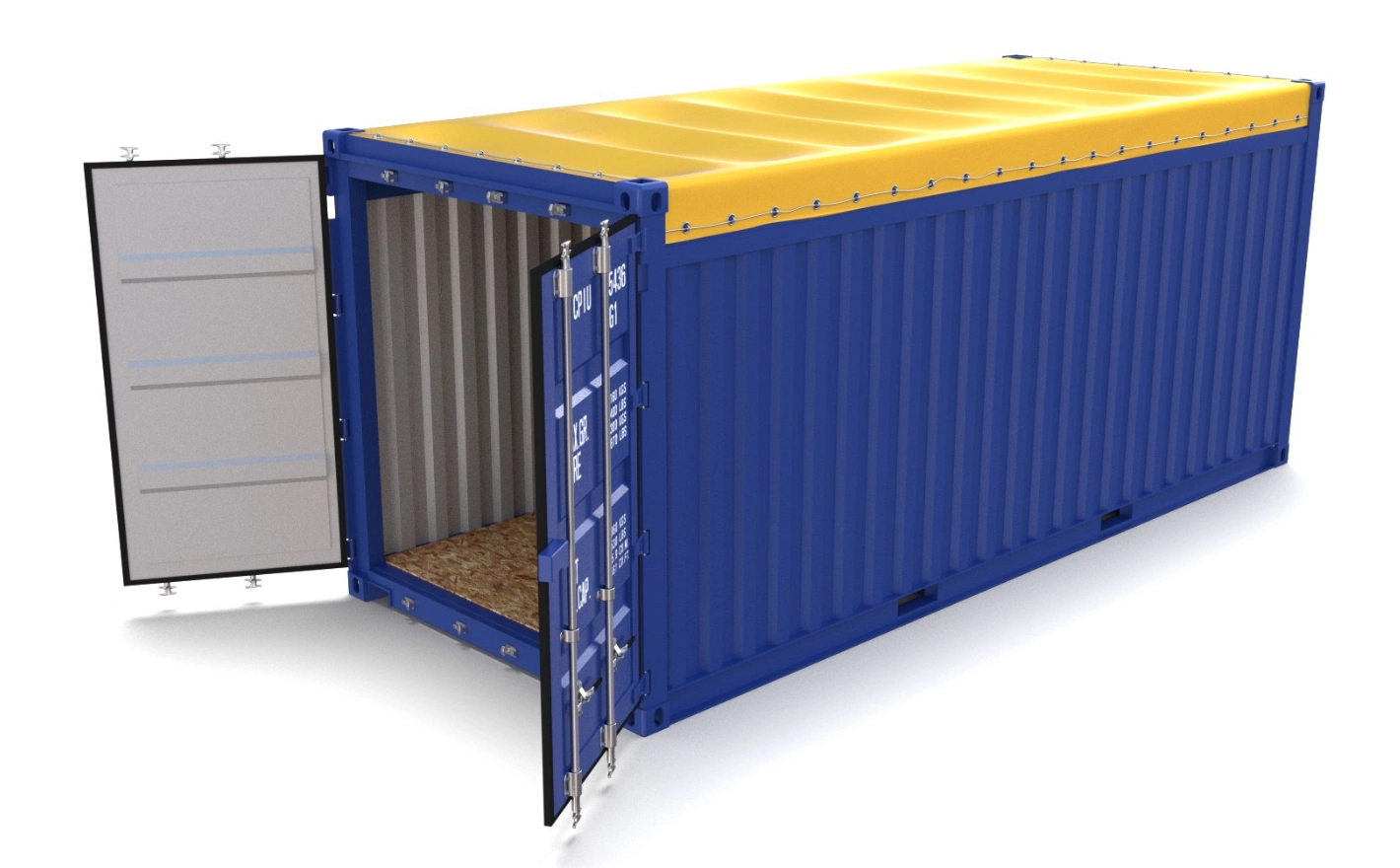
20ft Open Top Container for Sale in the US | Pelican Containers

 Specifications for 8’6″ / 30,480 kg
Internal DimensionsLength (mm)
Width (mm) 
Height (mm)
5,898
2,350
2,348
Door OpeningWidth (mm) 
Height (mm)
2,340
2,280
Roof OpeningLength (mm)
Width (mm)
5,680
2,252
Hatch OpeningWidth (mm)1,940
Load Capacity(m³)32.5
Container Weight(kg)2,380
Max. Load Capacity(kg)28,100

OPEN TOP CONTAINER – 40 FEET

 Specifications for 8’6″ / 30,480 kg
Internal DimensionsLength (mm)
Width (mm) 
Height (mm)
12,022
2,350
2,348
Door OpeningWidth (mm) 
Height (mm)
2,340
2,280
Roof OpeningLength (mm)
Width (mm)
11,798
2,230
Hatch OpeningWidth (mm)1,940
Load Capacity(m³)66.3
Container Weight(kg)3,880
Max. Load Capacity(kg)26,600
Glossary

Your guide to logistics terminology

Understanding the transport and logistics industry – word by word… It seems that the transport and logistics industry has its own language, with more than 5,000 acronyms, words, phrases, and terms, along with formal legal definitions. We have compiled a list of supply chain terminology featuring some of the most commonly used logistics and freight forwarding terms, acronyms, words, and phrases, and created a list of the most common acronyms and terms associated with P2P.

3PL (Third-party logistics)

The use of external logistics service providers for distribution, warehousing, and transportation.

4PL (Fourth-party logistics)

A more advanced form of logistics than 3PL; it coordinates and optimizes the entire supply chain as the lead partner.

AEO (Authorised Economic Operator)

A company authorized by the customs authority for secure and reliable international trade.

Autonomous vehicle

A self-driving car that operates without the need for a driver, also known as a “self-driving car” or “robot car.”

B/L (Bill of Lading)

Cargo manifest – an official document containing a detailed list of the cargo on a vessel.

Carinsko skladište (Bonded warehousing)

A warehouse where goods are stored without paying customs duties until they are ready for distribution.

Hladni lanac (Cold chain)

A controlled supply chain that maintains a constant temperature for food and pharmaceuticals.

Usklađenost (Compliance)

Processes and products that comply with legal and industry requirements.

Opasna roba (Dangerous goods)

Substances that pose a risk to people, the environment, or property due to their characteristics.

Digitalizacija (Digitalisation)

The introduction of digital technology into business processes for efficiency and automation.

Digitizacija (Digitisation)

Converting analog data into digital form.

FTL (Full Truckload)

Full truckload – a shipment that occupies the entire truck or is transported independently for faster delivery.

GDP

“Good Distribution Practice” – guidelines for the distribution of medicines, or “Gross Domestic Product” – the total domestic output.

Prijevoznik (Haulier)

A company that provides road freight transportation services.

Opasan teret (Hazardous cargo)

Goods that pose a risk of explosion, fire, or poisoning during transport.

Zdravstveni sektor (Healthcare vertical)

The sector that encompasses biotechnology, pharmaceuticals, and healthcare facilities.

Incoterms®

International commercial terms that define the obligations of the buyer and seller during the transportation of goods.

Lead logistics

The lead logistics partner that coordinates and manages all 3PL providers in the supply chain.

Metar utovara (Load metre)

One linear meter of space in a truck used to calculate transportation costs.

LTL (Less than Truckload)

Less-than-truckload – goods share space with other shipments, a more economical option than FTL.

Robot car

A car that drives itself, also known as an autonomous vehicle.

Self-driving car

A vehicle that uses sensors and AI technology to drive without human control.

SOP (Standard Operating Procedure)

A standardized procedure that ensures consistent execution of work tasks.

TEU (Twenty-foot Equivalent Unit)

A standard measure of container capacity of 20 feet; one 40-foot container equals 2 TEUs.

TMS (Transport Management System)

Software that helps plan, track, and optimize transportation operations.

Praćenje pošiljaka (Track and trace)

The process of tracking the location and status of goods within the supply chain.

WMS (Warehouse Management System)

Software for managing warehousing and distribution of goods.

W/M i RT

Labels in LCL shipping that indicate the billing method – by weight or volume, whichever is greater.

Billing factor for LCL

A pricing method based on the greater value between the shipment's weight and volume.

CIF vs FOB

CIF includes costs, insurance, and freight; with FOB, the buyer assumes costs from the point of loading.

CIF/CIP insurance

Cargo insurance is included in the price, but often does not cover the full value of the shipment.

Container tare

The empty weight of the container, needed to calculate the VGM if not indicated on the label.

VGM (Verified Gross Mass)

The total verified weight of the container as required by the SOLAS convention.

Responsibility for the VGM (Verified Gross Mass)

The shipper is responsible for the accuracy, issuance, and delivery of the VGM certificate.

Methods for calculating VGM (Verified Gross Mass)

Weighing the entire container or summing the weight of the cargo and the container’s tare.

Deadline for VGM submission

The VGM must be submitted before the container is loaded onto the vessel.

Euro pallet vs. industrial pallet

The Euro pallet (1200 × 800 mm) is smaller than the industrial pallet (1200 × 1000 mm).

Telex release

Electronic authorization for cargo release without the original bill of lading.

ADR

International agreement on the carriage of dangerous goods by road.

Stackable and non-stackable shipments

Stackable shipments can be stacked on top of each other, while non-stackable shipments require separate space.

MSDS or STL

MSDS refers to a Material Safety Data Sheet; STL refers to the technical specifications of a product.